
Students allege serious police excesses during Jantar Mantar protest; reports of treatment of women protesters trigger outrage as request for urgent Supreme Court intervention reportedly fails to secure immediate hearing
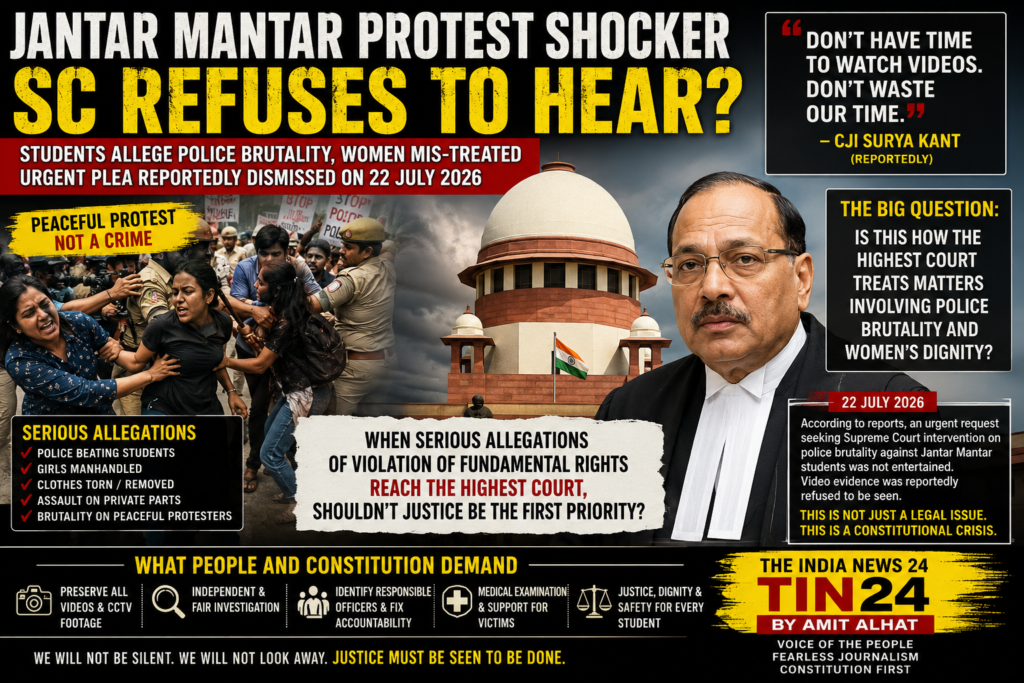
SPECIAL REPORT | 22 JULY 2026
By AMIT ALHAT
Editor-in-Chief | THE INDIA NEWS 24 – TIN24
NEW DELHI: What happens when disturbing allegations of police violence against protesting students reach the doorstep of India’s highest constitutional court—and urgent judicial intervention does not immediately follow?
That question has emerged at the centre of an intensifying national debate following the controversy surrounding student protests at Jantar Mantar, New Delhi, alleged police action against protesters, and a reported attempt on 22 July 2026 to seek urgent intervention from the Supreme Court of India.
Videos and accounts circulating in the public domain have generated serious allegations about the manner in which protesters were handled by police.
Particularly disturbing allegations have emerged concerning the treatment of women protesters.
But amid the anger, viral videos and competing narratives, another development has now attracted national attention:
What exactly happened when the matter was brought before the Supreme Court?
And perhaps the larger constitutional question—
When citizens allege that the coercive power of the State has crossed constitutional boundaries, how quickly should the justice system respond?
THE COURTROOM MOMENT THAT TRIGGERED A BIGGER CONTROVERSY
According to media reports concerning proceedings on 22 July, an attempt was made before a Supreme Court Bench headed by the Chief Justice of India to draw urgent judicial attention to alleged police brutality against protesters.
Video material concerning the alleged incidents was reportedly referred to while seeking intervention.
Reports attributed remarks to the Court indicating that it was not inclined to spend time watching such videos and declining the request for immediate intervention.
This reported exchange rapidly became controversial.
However, an important journalistic distinction must be maintained.
TIN24 has not independently established from an official Supreme Court transcript that every expression circulating on social media was actually used by the Chief Justice of India.
In particular, claims circulating online attributing expressions such as “foolish matter” should not be presented as established quotations unless confirmed through an authoritative court record.
But even without relying on disputed quotations, the underlying controversy raises questions that cannot simply disappear.
WHAT DID THE VIDEOS ALLEGEDLY SHOW?
Accounts and videos circulating from the protest have led to allegations that students were subjected to physical force during police action.
More serious allegations concern female protesters.
Claims circulating publicly include allegations of women being physically manhandled, assaulted or subjected to treatment affecting their clothing and bodily dignity.
These are allegations requiring independent investigation and verification.
TIN24 is not declaring any individual police officer guilty merely on the basis of viral footage.
Videos can be incomplete.
Clips can lack context.
Social-media posts can contain inaccurate descriptions.
But when allegations concern possible violence against women, bodily dignity and potentially disproportionate use of police force, the answer cannot simply be to ignore the evidence.
The evidence must be preserved, authenticated and investigated.
Who recorded the original videos?
Are complete, unedited versions available?
What do CCTV cameras show?
Did police authorities conduct official videography?
Which officers were deployed?
Were women police personnel present where female protesters were detained?
Were any protesters medically examined?
Were injuries officially documented?
Were complaints filed?
These are questions that an evidence-based investigation can answer.
A VIDEO IS NOT A JUDGMENT — BUT IT CAN BE EVIDENCE
The controversy also raises an important legal distinction.
A viral video does not automatically prove a criminal offence.
But neither should potentially important video evidence be dismissed merely because it originated on a mobile phone or social-media platform.
Electronic evidence can become extremely significant when properly preserved and authenticated.
The immediate priority should therefore be preservation of:
CCTV footage, police videography, original mobile-phone recordings, photographs, medical records, detention records, police deployment records and eyewitness accounts.
Delay can be dangerous.
CCTV systems may overwrite recordings.
Mobile files may be compressed or altered through repeated social-media sharing.
Metadata may be lost.
Memories of witnesses may become less precise.
That is why evidence preservation—not political shouting—should be one of the first institutional responses to allegations this serious.
THE CONSTITUTIONAL QUESTIONS ARE BIGGER THAN ONE VIRAL CLIP
The Constitution of India does not guarantee an unlimited right to protest anywhere, at any time and in any manner.
Public assemblies can lawfully be regulated.
Police can intervene where circumstances legally justify intervention.
But State power is not unlimited either.
Police action remains subject to constitutional and statutory limitations.
Article 14 protects equality before law and equal protection of laws.
Article 19 protects important democratic freedoms, subject to constitutionally permissible reasonable restrictions.
Article 21 protects life and personal liberty and has developed through constitutional jurisprudence into a powerful guarantee encompassing human dignity.
The central legal question therefore cannot simply be:
“Were the students protesting?”
The deeper questions are:
What were they doing at the precise moment force was used?
Was police intervention legally justified?
What level of force was used?
Was that force necessary and proportionate?
Were women protesters treated according to law and established safeguards?
Did any individual officer cross the line from lawful policing into unlawful violence?
Those questions require facts.
And facts require investigation.
DID THE SUPREME COURT “REJECT THE CASE”?
This distinction is extremely important.
A reported refusal to entertain an urgent oral request, watch videos immediately, grant urgent listing or exercise suo motu jurisdiction should not automatically be described as a final Supreme Court judgment rejecting all allegations of police brutality.
Those are legally different things.
If no substantive adjudication took place on evidence, then the underlying allegations have not necessarily been judicially determined to be true or false.
The affected persons may still have legal remedies depending upon the precise procedural history of the matter.
That could potentially include approaching the competent constitutional court through a properly instituted petition supported by affidavits and authenticated evidence.
The Delhi High Court, exercising jurisdiction under Article 226 of the Constitution, may have an important role depending upon the facts, existing proceedings and relief sought.
WHY THE RESPONSE OF THE HIGHEST COURT MATTERS
The Chief Justice of India occupies one of the most consequential constitutional offices in the Republic.
Public confidence in the judiciary depends not merely upon judgments but also upon the perception that allegations involving fundamental rights receive fair institutional consideration.
At the same time, courts face enormous caseloads.
Not every viral incident can automatically result in the Supreme Court taking suo motu cognisance.
Not every request for urgent mentioning must necessarily be accepted.
And the Supreme Court cannot replace every statutory authority, trial court or High Court in the country.
Those realities must be acknowledged.
But another reality must also be acknowledged.
When allegations concern potentially serious police violence, treatment of women protesters and possible violations of bodily dignity, citizens are entitled to ask whether the institutional response was adequate.
That question can be asked respectfully.
It can be asked constitutionally.
And it can be asked without attacking the independence of the judiciary.
Judicial independence and judicial accountability are not enemies.
A strong democracy requires both.
SHOULD THERE BE ACCOUNTABILITY IF THE REPORTED FACTS ARE VERIFIED?
This controversy should not become a competition in political slogans.
Accountability must follow evidence.
If an investigation establishes that protesters attacked police personnel or committed offences, those facts should also be reported and dealt with according to law.
If, however, evidence establishes that individual police personnel used unlawful or disproportionate violence, accountability must follow regardless of rank.
Likewise, public discussion concerning judicial conduct should be based on the authentic record—not fabricated quotations or edited social-media narratives.
If controversial remarks are attributed to a constitutional authority, the complete context should be established through the most authoritative record available.
SHOULD THE CJI RESIGN? A CONSTITUTIONAL QUESTION, NOT A SOCIAL-MEDIA VERDICT
Some citizens may ask whether a controversy involving the reported handling of such a serious request justifies a demand for the resignation of the Chief Justice of India.
Citizens in a democracy are entitled to peacefully and lawfully call for accountability or resignation from holders of public constitutional office.
But there is a major constitutional distinction between demanding resignation and legally removing a Supreme Court judge.
A Supreme Court judge may voluntarily resign in accordance with Article 124(2) of the Constitution.
Removal, however, is governed by the stringent constitutional mechanism under Article 124(4) and applicable law and requires the prescribed parliamentary process relating to proved misbehaviour or incapacity.
Therefore, disagreement with a judicial decision—or even strong criticism of the handling of a matter—does not automatically establish the constitutional grounds required for removal.
Any demand for resignation should consequently be based on verified facts, constitutional reasoning and responsible public debate rather than misinformation.
THE QUESTIONS INDIA DESERVES ANSWERS TO
The controversy of 22 July leaves several questions demanding transparent answers:
Were students subjected to excessive or unlawful police force at Jantar Mantar?
What exactly happened to the women protesters seen or described in circulating material?
Do complete and unedited recordings support the allegations being made?
What CCTV and official police videography exists?
Have all electronic records been preserved?
Were injured protesters medically examined?
Were complaints from affected women formally recorded and investigated?
What exactly was requested before the Supreme Court?
Was there a formally filed petition, an urgent mentioning, or a request for suo motu intervention?
What exactly did the Court say?
Is there an official order or authoritative record clarifying the proceedings?
And most importantly—
Who will independently establish the truth?
TIN24 EDITORIAL POSITION: PRESERVE THE EVIDENCE, INVESTIGATE THE ALLEGATIONS, LET THE TRUTH SPEAK
The India News 24 – TIN24 believes that neither police personnel nor protesters should be declared guilty merely through social-media trials.
But allegations of serious violence cannot be buried beneath procedural technicalities or political narratives.
Every original video should be preserved.
Every relevant CCTV recording should be secured before it can be overwritten.
Every alleged victim should have access to lawful medical examination and legal remedies.
Every police officer accused of wrongdoing deserves due process.
Every student making an allegation must be heard according to law.
And every constitutional institution must remain open to legitimate public scrutiny.
The credibility of democracy is tested not when institutions are praised—
but when difficult questions are asked of those who exercise power.
The Jantar Mantar controversy is therefore no longer only about one protest.
It has become a larger question about police accountability, women’s dignity, students’ constitutional freedoms, access to justice and public confidence in India’s institutions.
The videos may eventually establish one version of events—or they may reveal a more complicated reality.
But there is one thing democracy cannot afford:
For the evidence to disappear before the truth is established.
THE QUESTION REMAINS:
“IF THE VIDEOS CONTAIN THE TRUTH, WHO WILL WATCH THEM—AND WHO WILL ANSWER?”
— AMIT ALHAT
EDITOR-IN-CHIEF
THE INDIA NEWS 24 | TIN24
Independent Journalism | Constitutional Accountability | Voice of the People

Author: The India News 24
TIN24 (The India News 24) The India News 24 (TIN24) is a Mumbai-based news Digital Media focusing on breaking news, local and regional issues in India, with content primarily in Marathi. It was established with an X (Twitter) presence since July 2022. Owner & News Editor: Amit Alhat Education: BA in Mass Communication Journalism (Graduate) Experience: 12 years in journalism Platforms: - Website: https://theindianews24.in - X (Twitter): https://x.com/the_indianews24 - YouTube: https://www.youtube.com/@theindianews247 - Instagram: https://www.instagram.com/theindianews_24

